
King County Previous Resident Sources
The best starting source depends on the period. Current parcel records establish the address and PIN. Landmark provides the modern deed chain, Archives microfilm continues it backward, and reverse directories or census material identify people listed at the place. No one source supplies a continuous line of previous residents.
| Source | Years covered | Where held | What it shows |
|---|---|---|---|
| Landmark recorded documents | Most records August 1, 1991 to present; PIN search 1997 to present | King County Recorder | Recorded parties, transfers, dates, parcel and legal links |
| Recorded-document microfilm | 1853 through July 31, 1991 | King County Archives | Earlier deeds, plats and easements |
| Real-property cards | 1937 to 1972 | Washington Digital Archives | Address variants, photo, sketch and construction details |
| Seattle reverse directories | Earliest identified 1928; fuller runs from 1938 | Seattle Room | Listed person or business by address |
| Seattle city directories | Selection 1867 to 1940; other volumes 1876 to 1996 with gaps | Seattle Room | Name, address, work and household clues |
| Historic census and newspapers | Series and title specific | Libraries and archives | Household identity, notices and life events |
For a recent transfer, begin with Assessor and Landmark. For a mid-century Seattle property, combine the card and reverse directory. Earlier work depends more on legal descriptions, ordinary name directories, maps, census series, and archive staff.
Fix the King County Parcel
Search the King County eReal Property system by address, parcel number, or condominium or apartment-complex name. Copy the situs address, PIN, owner of record, jurisdiction, and legal description. Keep the mailing address separate. It may identify only where tax correspondence goes.
Then open the PIN in Parcel Viewer. A map check catches address formatting errors and shows whether the subject is a condominium, split lot, merged parcel, common area, or another unusual geometry. Lot lines are approximate and not a legal survey. A parcel is the research unit, not proof that one household occupies it.
Note: Record the assessment cycle and source date because ownership and value fields are not live occupancy signals.
Trace King County Owners Backward
The King County Landmark index supports party name, role, match type, document type, book or page, parcel, date, recording number, legal description, and Torrens searching. Use those dimensions to build a chain of title, which is the linked sequence of recorded property transfers.
- Find today's owner and legal description in the Assessor record.
- Search the owner as grantee, the party receiving an interest, and locate the deed by which that person acquired it.
- Record the grantor, the party giving the interest, along with the recording number, date, deed type, parcel, and legal description.
- Search that grantor as an earlier grantee. Repeat while names and land descriptions connect.
- At the online cutoff, carry the last recording reference to Archives microfilm or request staff help and a copy.
- Grantor
- The person or entity transferring a recorded property interest.
- Grantee
- The person or entity receiving that interest.
- Chain of title
- The linked sequence of recorded transfers for the same land.
- Legal description
- Lot, block, plat, or survey language identifying land when its street label changes.
An index entry is not the complete instrument. Open or order the image when wording, signatures, reservations, or certification matters.
Cross King County's 1991 Boundary
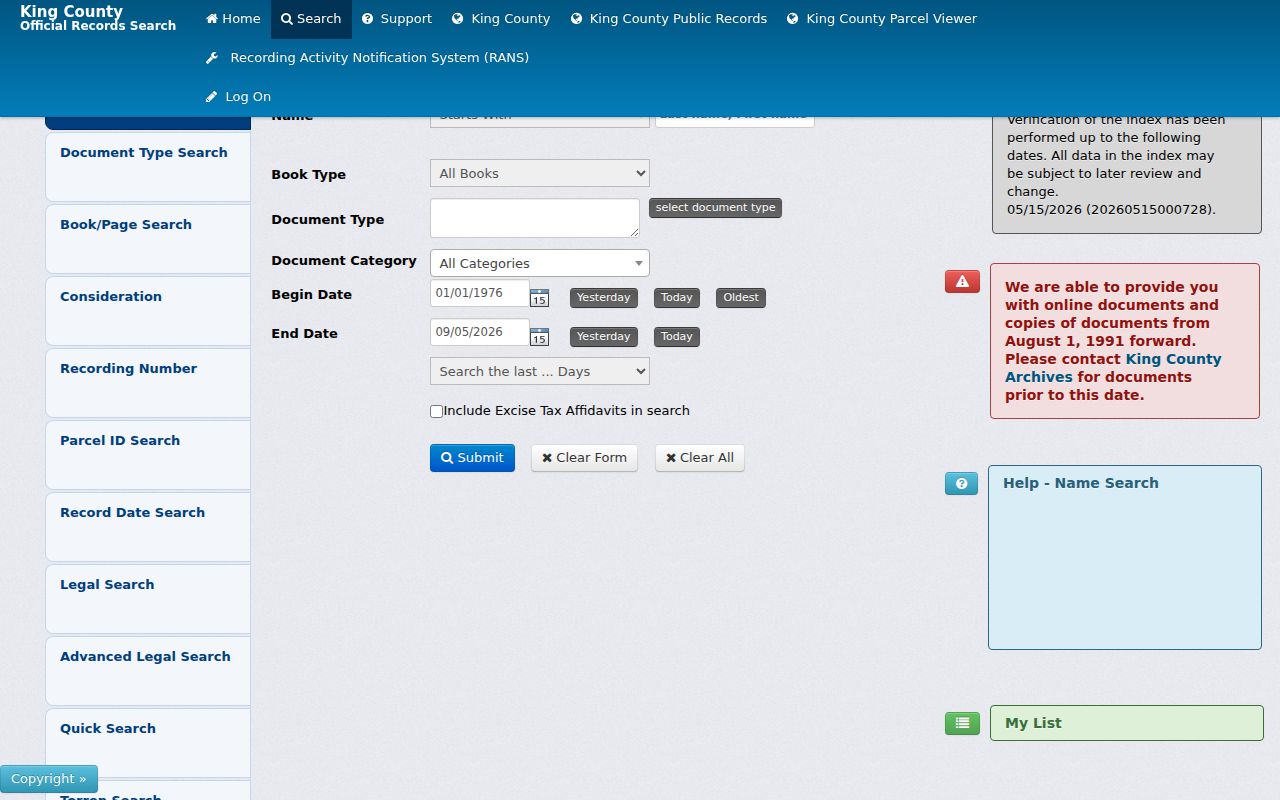
Landmark's general online coverage begins with most documents recorded on or after August 1, 1991. Parcel-ID searching is described as 1997 to current. Treat these as separate cutoffs. A blank PIN result from 1993 does not mean no deed exists, and a blank online result before August 1991 does not establish a gap.
King County Archives holds recorded-document microfilm from 1853 through July 31, 1991. Its phone and email service runs weekdays, and walk-in research-room hours are Tuesday and Wednesday. Most research requires an appointment and advance preparation, but the Archives says its recorded-document microfilm needs no appointment. The copy-order page offers another remote route; its stated policy lists no duplication fee for uncertified copies.
Review the grantor and grantee controls shown below before starting a backward chain.
See King County's Property Cards
The King County real-property card collection contains 82,420 records from 1937 through 1972. A WPA survey began the work in 1937 and was completed in 1940, while updates continued for later decades. Cards can contain an exterior photograph, construction description and date, sketch, parcel number, segregation dates, former house number, former street, former address, addition, and notes.
Those fields make the series valuable to previous-resident research when the same building appears under a new number. Yet the official description warns that cards do not reliably provide every owner, purchase price, taxes paid, blueprints, interiors, or a precise building location. Use the image as building and address evidence, then return to deeds and directories for people.
Place King County Past Residents
Ownership is only one timeline. Seattle reverse directories let an address lead to a listed person or business. The earliest identified house-and-street volume is from 1928, with full reverse runs identified from 1938 onward. Earlier books are mainly name-to-address tools. The collection's years, publishers, and abbreviations are covered on the King County city directories page.
- Search the street section and copy the house number, name, business notation, volume year, and page.
- Find the same name in the alphabetic section and record work, spouse, telephone, or address context shown there.
- Compare the closest open census and use age, birthplace, profession, or relatives to separate people with the same name.
- Search a newspaper title and date range for obituary, sale, social, or probate context, then label the result by what it actually states.
The 1885 King County census has 16,201 records and can provide age, birthplace, profession, marital status, literacy, disability, and citizenship fields. It is not a street directory, but those details can distinguish two similarly named residents. The 1906 Southeast Seattle census finding aid names 4,282 people and supplies another neighborhood-scale historical layer.
Date a King County Address
The official Seattle and King County building-history guide recommends a chain that includes directories, atlases, Sanborn fire-insurance maps, property cards, deeds, plats, and permits. Sanborn material listed by Seattle Public Library spans 1867 to 1970, with exact Seattle coverage varying by sheet. It can date a footprint or changed street number, not identify every person who stayed there.
Plats and surveys explain when a parcel took its present form. Permits can date work and name an applicant or owner, but King County Local Services covers unincorporated parcels. Incorporated addresses must be routed to their city. Preserve the issuing jurisdiction and record date when annexation later moves the parcel.
Repair King County Historic Addresses
Georgetown Ordinance 50 of August 8, 1904, addressed building numbering. Seattle street-name finding aids span 1908 to 1986, and the annexation map reaches back to 1869. Ballard even voted against annexation in 1905 before approving it in 1907. These details explain why an old entry may sit under another number, street, or municipal catalog.
Test the former building number and street name from the property card. Compare a map from the target period, then search the legal description and the former municipality. ZIP codes are a later postal layer and should never be projected backward onto a nineteenth-century directory.
Note: A changed label is not a broken history when the PIN, legal description, map, and neighboring lots still align.
Use King County Archive Context
Seattle Public Library's genealogy collection has more than 40,000 bound volumes plus microfilm and periodicals. The Seattle Room adds more than 50,000 non-circulating maps, photographs, city documents, oral histories, and yearbooks. Staff offer free research help, and the special-collections room uses appointments. A person may therefore appear in a photo caption or oral-history description even when no directory entry survives.
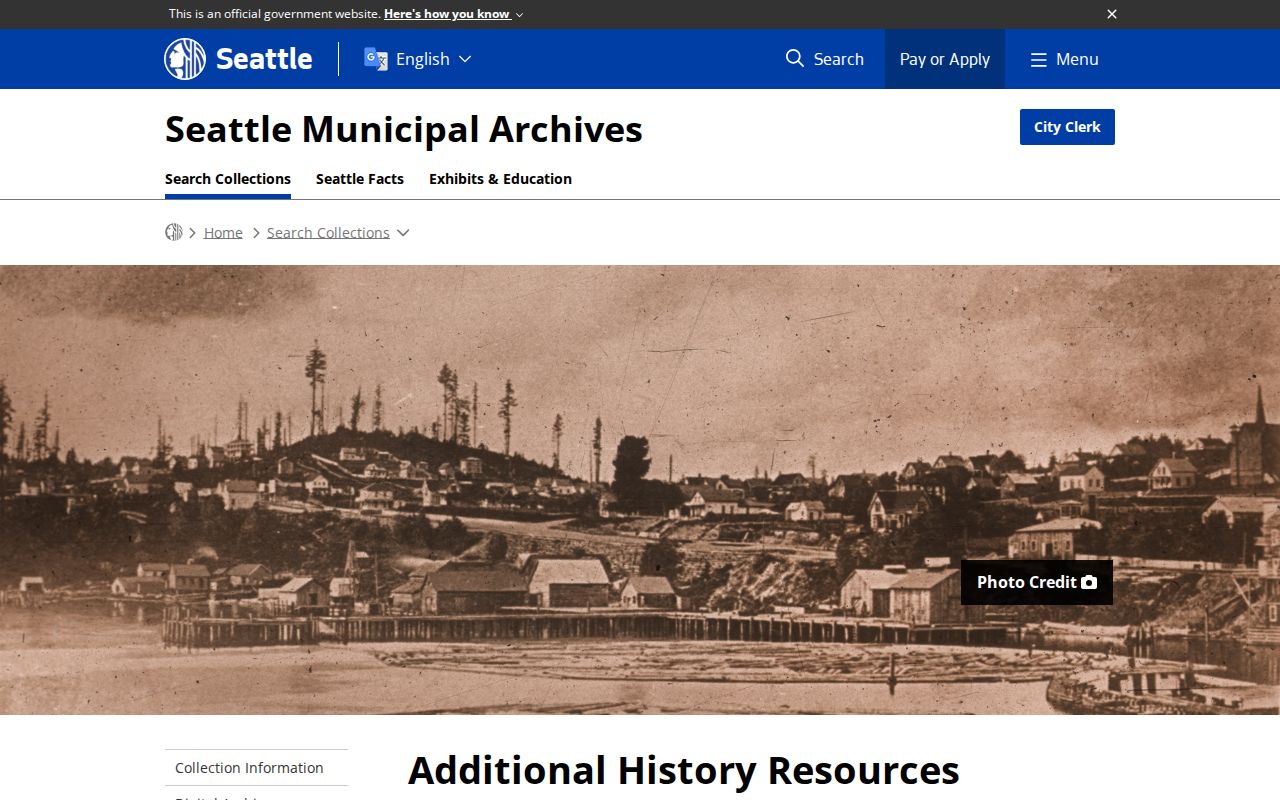
The Seattle Municipal Archives property-history resources provide another route into maps, annexation, and city records.
Label King County Previous Residents
End with a timeline that distinguishes owner of record, grantor, grantee, directory-listed resident, census household member, permit applicant, and obituary subject. Dates can overlap without conflict because each record was made for a different purpose. A directory line is evidence for its edition, not proof of continuous residence.
Protected addresses remain protected. Washington's Address Confidentiality Program, sealed cases, restricted vital records, and private account data are not opened by house-history research. When evidence is uncertain, state that uncertainty instead of assigning a living person to an address.
Lawful use. Research King County previous residents for family history, estate work, property history, or personal curiosity. Never use a result to track, harass, or harm a living person.