
King County Directory Collections
King County city directory research is centered on Seattle Public Library. Its Seattle Room has a selection of Seattle volumes from 1867 through 1940. The county's building-history guide reports R.L. Polk and other directories from 1876 through 1996, with possible gaps. Polk is the main later publisher, and annual issues begin in the late 1880s with some exceptions. Always record the title page, year, publisher, and page. Those details prevent one volume's date or publisher from being assumed for the next.
| Collection | Years | Where held | How to use it |
|---|---|---|---|
| Seattle city directories | Selection, 1867–1940 | Seattle Room | Physical shelves, catalog, and staff help |
| R.L. Polk and other Seattle directories | 1876–1996, gaps possible | Seattle Room | Consult the volume and confirm its title page |
| Seattle House and Street Directory | Earliest verified reverse volume, 1928 | Seattle Room | Search an address or street |
| Full reverse directory run | 1938 onward | Seattle Room and local collections | Start by street, then check the name section |
| Real-property cards | 1937–1972 | Washington Digital Archives | Free online name, address, and parcel research |
| King County census | 1885 | Washington Digital Archives | Free name and Soundex search |
The dates describe documented holdings, not a promise that every year is on the shelf. Ask staff to confirm a year before a trip. The verified repositories are the Seattle Room, Seattle Municipal Archives, Washington State Archives, and Puget Sound Regional Archives. No current official King County historical-society collection portal was verified, so a directory search should begin with these public collections.
King County Directories at SPL
The Seattle Room is a non-circulating collection on Level 10 of the Central Library at 1000 Fourth Avenue. Its more than 50,000 items include directories, maps, photographs, city documents, oral histories, and yearbooks. Appointments are listed Tuesday through Thursday from 1 to 5, and visits may run from 30 minutes to two hours. Check the current schedule before going.
The library's genealogy collection is on Level 9. It holds more than 40,000 bound volumes, plus periodicals, pamphlets, and microfilm. Genealogy librarians offer free one-on-one help in person, by phone, and virtually. Licensed databases include HeritageQuest, HeritageHub, Newspapers, and Ancestry Library Edition, but access depends on the license and location. Remote access should never be assumed.
The Seattle Public Library genealogy page shows the starting point for this city directory work.
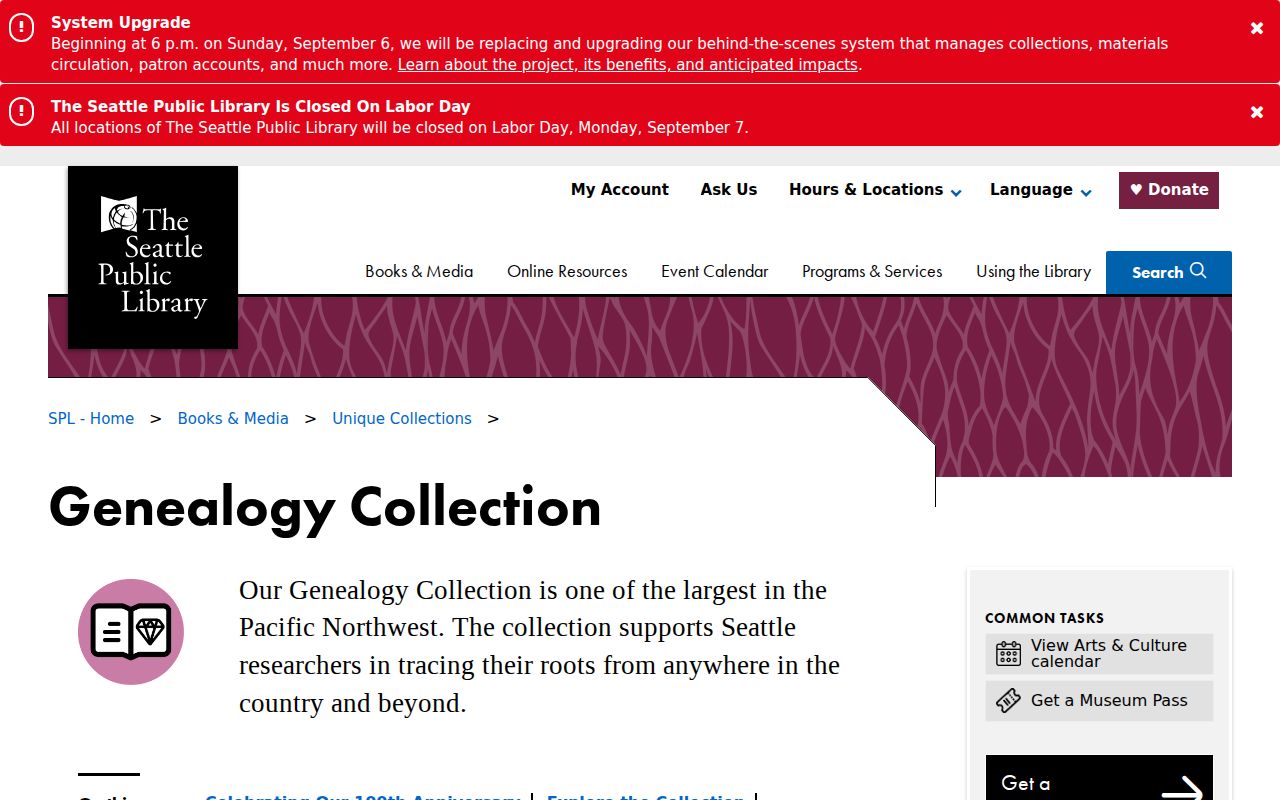
Use the collection description to prepare years, names, and address variants before asking a librarian to check the shelf.
King County Reverse Directory Years
Older city directories mainly move from a person's name to an address. Seattle's earliest verified House and Street Directory reverses that route in 1928. The research identifies full reverse runs from 1938 onward. That change matters when a family name has been lost but a house number remains. Browse the street, find the numbered property, and then carry the listed name back to the alphabetic pages.
This is an important limit, too. A reverse section can list a household or business tied to an address during the directory's canvass. It does not prove legal ownership or present occupancy. Renters, children, new arrivals, people who moved between surveys, and unlisted telephone users may not appear.
Read King County Directory Entries
A King County city directory entry should be copied as printed, including initials, punctuation, and abbreviations. Fields vary by volume. The local collection descriptions support looking for a name, residence address, occupation or business, and telephone context in later books. Record whether the result came from the alphabetic section or the street section. Photograph or transcribe the abbreviation key and front matter before interpreting a short code.
| Name line | Spelling, initials, household members, or a business name as printed |
|---|---|
| Place line | Residence street and house number, if the volume supplies them |
| Work context | Occupation or business details, depending on the edition |
| Telephone | A later-volume contact clue, not proof of present use |
| Source details | Year, title, publisher, page, and section placement |
- Criss-cross directory
- A reverse directory arranged by street and house number instead of surname.
- Householder index
- A list that connects a person or household name with a listed address.
- Abbreviation key
- The volume's own guide to shortened words and marks. Save it because meanings can change between publishers.
Front matter can explain transit routes, street names, business classes, and municipal notes. It may show why an entry was filed as a business, boarding arrangement, or address in a different civic unit. This context often resolves a result that first looks inconsistent.
King County Cards Add Detail
The King County real-property card collection adds a visual and parcel-based layer to directory research. The WPA survey began in 1937 and was completed in 1940, while the series continues through 1972. Its 82,420 records can include an exterior photograph, a construction sketch, tax assessments, and later updates. Search fields include location, parcel number, house number, street, addition, former building number, former street name, former address, and notes.
A card does not reliably list every owner, purchase price, tax payment, blueprint, interior, or exact building placement. Treat it as one source. Its former-number and former-street fields are especially useful when a directory address stops matching the modern map.
The Washington Digital Archives collection interface also illustrates how King County historical series are searched.
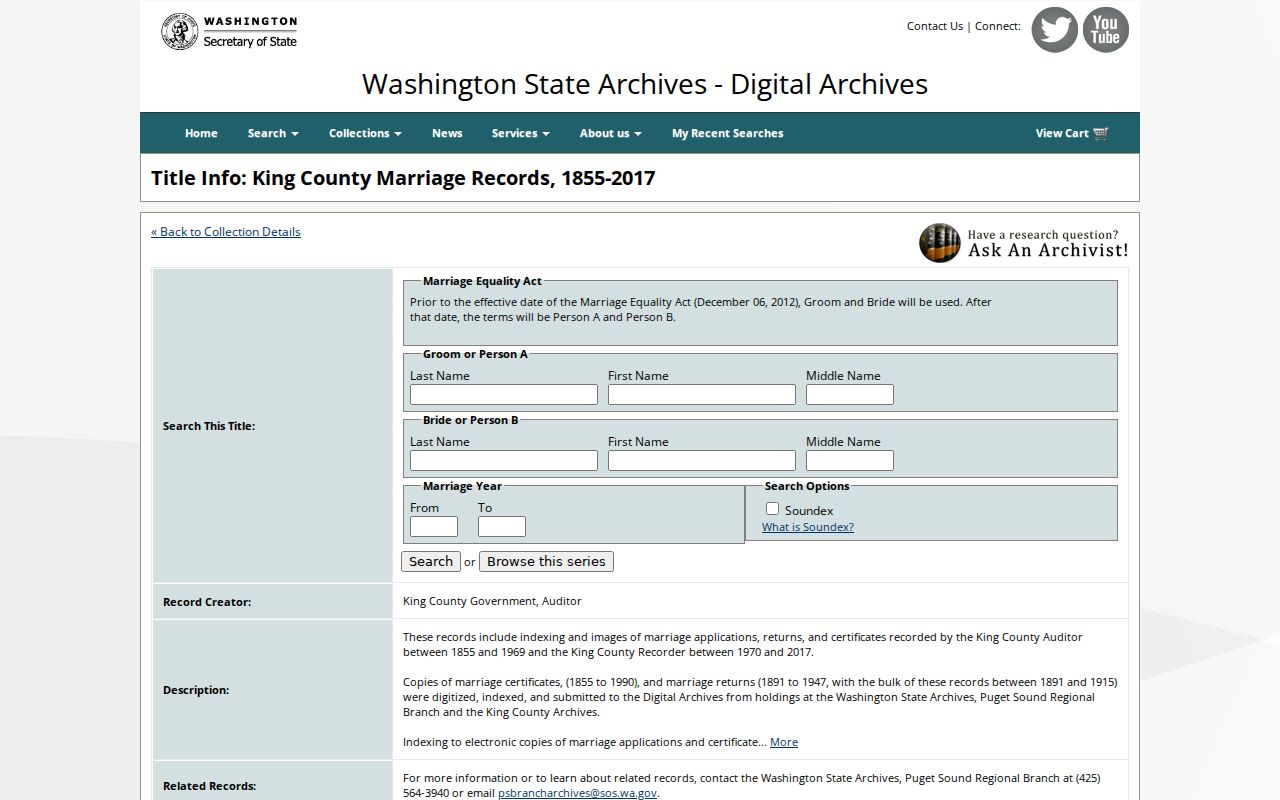
Use People Search, Soundex, a series choice, or Browse this series when an exact spelling finds nothing.
King County Addresses Change Jurisdiction
Seattle did not always include Ballard, Columbia, Georgetown, South Park, Southeast Seattle, South Seattle, West Seattle, and Ravenna. The Seattle Municipal Archives annexed-cities reference supplies maps and dates that help route an old address to the right catalog. Ballard, for example, voted against annexation in 1905 and approved it in 1907.
Search the former municipality's clerk files, minutes, assessment rolls, and ordinances when the directory year predates annexation. Georgetown's Ordinance 50 of August 8, 1904 dealt with building numbering. That small record can explain why a present house number is missing from an older book. Test the old number and street-name variant before concluding that no entry exists.
The Seattle Municipal Archives history resources show the broader set of local records that can support the directory trail.
Maps, municipal files, and address histories supply context when the printed directory alone cannot resolve a changed place name.
King County Newspapers Extend Directories
Directories give annual snapshots, while newspapers can supply events between editions. Seattle Public Library lists the Seattle Times from 1895 to the present and the Seattle Post-Intelligencer from 1901 through 2022 through its Seattle Room description, databases, or microfilm. Search a name with a street, date range, relative, or business. An obituary, social notice, legal notice, or advertisement may explain a move or name change.
No verified all-years SPL obituary-name index was found. The fallback is direct newspaper title, date, and name searching, followed by librarian help. Washington State Digital Newspapers and Chronicling America offer other newspaper routes. Yearbooks, photographs, oral histories, and neighborhood collections in the Seattle Room may also identify a person when no city directory line survives.
King County Directory Time Marks
The most useful dates describe access changes, not one seamless run. Put each result on its own source clock.
| Year | Directory research milestone |
|---|---|
| 1867 | Start of the Seattle Room's described directory selection |
| Late 1880s | Annual Polk issues begin, with exceptions |
| 1928 | Earliest verified Seattle House and Street Directory |
| 1938 | Start of the identified full reverse-directory run |
| 1996 | End of the broader printed-directory span in the county guide |
Historical indexes add other clocks. The 1885 county census has 16,201 records, and the 1906 Southeast Seattle census finding aid names 4,282 residents. These are historic snapshots, not current rolls. Use age, birthplace, occupation, or another independent detail to distinguish common names.
Trace King County Family History
Use King County city directories as dated links in a chain. A person may vanish because of a move, death, missed canvass, changed spelling, or residence outside the directory boundary. One missing year does not decide which explanation is right.
- Find the first likely name entry. Save the year, title, publisher, page, spelling, and address.
- Move one issue at a time. Log each address and mark years that are absent from the verified holdings.
- For 1928 or a later reverse volume, check the street section and compare the household or business at that number.
- Pair the directory with the 1885 county census or another census year. Use age, birthplace, or occupation to test identity.
- Check maps, property cards, newspapers, marriage or death indexes, and annexation records for independent support.
Washington State Library's county-directory holdings page gives another access route, but the library announced closure to the public on July 1, 2025 and described limited Thursday appointments from 1 to 4 through its reference email. Verify availability before travel. Puget Sound Regional Archives in Bellevue remains important for pre-1990 property cards and house photographs.
Once a historical name is well supported, use the King County resident lookup for a modern verification path. Keep the historic directory finding separate from any claim about who lives at the address now.