
Start a King County Search
Begin with the strongest detail you already have. A street address points first to the Assessor and Parcel Viewer. A person’s name can be checked in the Recorder’s grantor and grantee index, the Washington Courts name search, or a historical directory. A date or era determines whether a web portal, a library volume, or archive microfilm is the right channel. These records do not make the same claim. The assessor names an owner of record, a deed index names parties to a recorded document, and a city directory records what a publisher printed in a given year.
No official source is a complete occupancy roll. Some residents own no parcel, skip publication in a directory, or have an address protected by law. Treat one result as a lead. Compare names, dates, addresses, parcel numbers, and record roles before deciding two entries refer to the same person.
Choose a source by its time span as well as its search key. Current property and court tools favor exact names, addresses, and identifiers. Printed directories work year by year. Older deeds move from Landmark to archive microfilm, and territorial or early state names may surface only in a historical index. Write down failed searches too. A spelling variant, former street number, annexation date, or portal cutoff often explains why an expected name is missing.
- Search the county property roll with the address or owner name, then save the parcel identification number.
- Use the voter lookup only for an individual registration check, and respect Washington’s limits on voter data.
- Run the Recorder index by party name, document type, parcel, or recording date.
- For an older Seattle household, compare the alphabetic and reverse city directory sections.
- When the online coverage ends, contact the archive, clerk, library, or responsible city office.
King County Directory Offices
Three county offices supply the main current record trails. The Recorder indexes deeds and other recorded instruments. The Assessor ties a parcel to an owner, physical address, legal description, and valuation data. Elections maintains registration and ballot information under state election law. Their public tools work as parts of a residents directory, but none certifies who is physically present today. For a parcel-by-parcel method, use the King County street directory.
King County Recorder’s Office
201 S Jackson Street, Suite 204
Seattle, WA 98104
206-477-6620
King County Elections
919 SW Grady Way, Suite 100
Renton, WA 98057
206-296-VOTE
King County Parcels Name Owners
The eReal Property search accepts a parcel number, site address, or owner name. A property detail may show the parcel number, jurisdiction, owner, legal description, land data, building age, assessed value, and mailing address. Keep the situs address, meaning the physical parcel location, apart from the mailing address used for notices. They can be different.
The Assessor result offers links to a tax bill, map, area report, glossary, and printable property detail. It establishes an assessment connection, not present occupancy. Carry the parcel number into Parcel Viewer and Landmark to compare geography with recorded ownership.
Parcel Viewer adds map context and related reports. A user can search an address, parcel, or condominium name, select a lot, and follow links to assessor data or district and development conditions. Its lot lines are approximate and are not a legal survey. The map is best used to locate the correct parcel and nearby geometry, while the Assessor and Recorder supply the named record trail.
The county’s live search is visible in the official assessor interface.
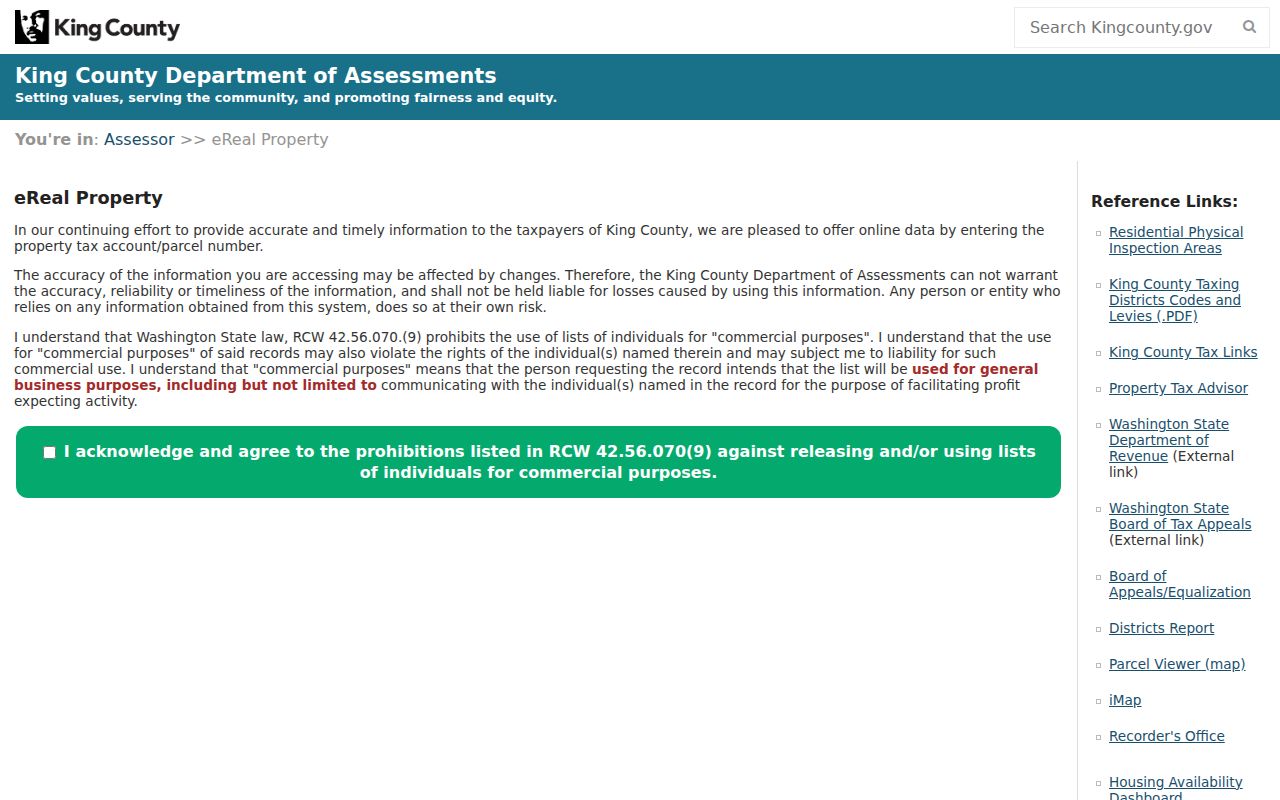
Its address and parcel routes make the property record a practical first step, while the result still needs a second source.
Search King County Landmark Records
Landmark Web indexes most recorded documents from August 1, 1991 forward. Search controls include party name, grantor or grantee role, document type, book type, recording date, recording number, legal description, and parcel ID. A grantor transfers an interest; a grantee receives one. Searching both roles can expose successive links in a property chain.
Parcel-ID searching has a narrower stated range, from 1997 forward. Earlier recorded property documents, covering 1853 through July 31, 1991, are on microfilm at King County Archives. The online index is free. An account and cart are used for document images or copies, and a certified copy is mailed. The index line and an uncertified image are reference evidence, not a certified record.
| Landmark field | Best use |
|---|---|
| Party and role | Separate grantors from grantees |
| Document type | Limit results to deeds, liens, plats, or other instruments |
| Parcel ID | Connect recordings to a known parcel from 1997 onward |
| Record date | Test a known transfer period |
| Legal description | Work with lots, plats, surveys, and condominiums |
The official Landmark screen shows these filters together.
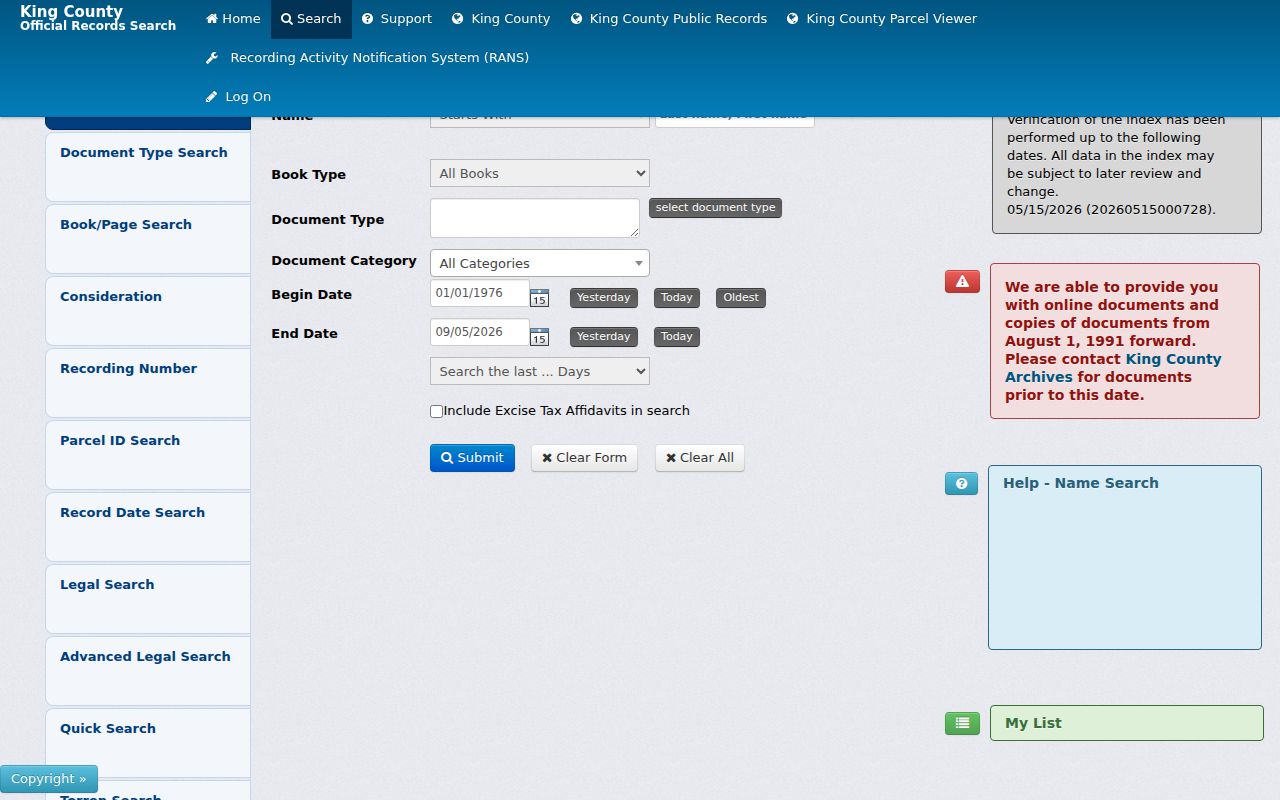
Use the role and date filters before opening results so common names do not create a misleading match.
King County Voter Record Limits
The My Voter Information tool is an individual lookup for registration and ballot details. It accepts combinations of identifying fields. A separate voter-data request process covers specified public fields under RCW 29A.08.710, with a political-purpose attestation and restrictions on commercial use, advertising, and solicitation.
Washington’s Address Confidentiality Program protects qualifying participants through a substitute address and special handling of voting records. A public-record request cannot override those protections. Do not infer that a failed voter search proves a person has left King County; registration status, spelling, eligibility, and protected data can all affect the result.
Bulk voter data follows a different route from the personal lookup. King County Elections asks the requester to describe the data and geography, provide contact information, and accept the use restrictions on the form. The stated response framework is five business days. Fees and file formats should be confirmed before a large request. Keep ballot activity separate from a residential conclusion, since election participation and current occupancy are not the same fact.
Current King County Resident Rolls
Current official systems describe a person in a specific role. Property records list owners, recorded documents list parties, and court indexes list case participants. Voter tools follow election law. Municipal permit and code records can add an address connection, but King County’s permit search covers unincorporated land while incorporated cities keep their own files. Match the source to the question before relying on a name.
| Source | Who It Lists | Keeper | Access |
|---|---|---|---|
| eReal Property | Parcel owners of record | King County Assessor | Free web search |
| My Voter Information | An individual voter’s registration and ballot details | King County Elections | Direct lookup |
| Landmark Web | Parties to recorded documents | King County Recorder | Free index; copies through cart or office |
| Court name searches | Parties in public case indexes | Washington and local courts | Portal, clerk, or courthouse |
| Permit and code files | Applicants, owners, parcels, and cases | County or responsible city | Search or records request |
A name shared by several people needs more than one identifier. Pair it with an address, date, parcel number, case number, or document role. The King County resident lookup focuses on verifying one person across these distinct systems.
Other official rolls can confirm a public role without exposing a private home. Washington’s business filing system searches entities, charities, and trademarks by names or registration identifiers. Professional licensing and contractor verification can establish a license, UBI, principal, bond, insurance, or status where the profession’s rules make those fields public. These are role records, not a King County residents directory of home addresses, so use them only for the fact they state.
Courts Confirm King County Names
The Washington Courts name and case search supplies a statewide index. King County Superior Court adds KC Script access, District Court uses eCourt, and Seattle Municipal Court publishes its own case information. Search by name, then retain the court, case number, filing date, party role, and case type. Those fields help distinguish people who share a name.
Online coverage varies. King County Superior Court permits online document review for specified case types filed from November 1, 2004, while older material may require the clerk, a courthouse terminal, microfiche, or a copy request. Sealed, juvenile, adoption, and protected family records remain restricted. An empty portal result is not proof that no case exists.
King County District Court and Seattle Municipal Court have their own search and copy channels. Older Seattle municipal cases require contact with the clerk. Superior Court’s Department of Judicial Administration handles the official case file and certified copies. A statewide index result should therefore lead to the local custodian named in the result. Never merge two people because their names look alike; verify the middle name, case role, filing court, and dates.
Vital Records Follow State Rules
The Washington Department of Health issues modern birth, death, marriage, and divorce certificates. Orders can be placed online, by mail, or through a local health department where available. Certified birth and death copies require identity and a qualifying relationship. Informational copies are broader but do not carry the same legal status.
Historical transfers follow different clocks. Birth and fetal-death records move to the State Archives after 100 years; deaths, marriages, and divorces transfer after 25 years. Marriage and divorce certificates are available through DOH for 1968 forward, while a divorce decree remains a court record. Record the event, date, county, and copy type before choosing an order channel.
King County Archives and Washington Digital Archives add historical paths. The digital King County marriage collection combines Auditor records from 1855 through 1969 with Recorder records from 1970 through 2017. Browse and Soundex options can help when an exact spelling fails. A historical index may lead to an image or archive reference rather than a certificate ready for legal use, so ask the custodian which copy meets the intended need.
Seattle Is One Records Layer
Seattle is the county seat, yet a King County address may fall in Bellevue, Kent, Redmond, Shoreline, another incorporated city, or an unincorporated area. City permit, code, archive, and municipal court files stay with the responsible municipality. County permits and code cases generally cover unincorporated property. Parcel Viewer or iMap should settle jurisdiction before a request is sent.
Seven Community Service Areas organize the unincorporated parts of King County: Bear Creek/Sammamish, Four Creeks/Tiger Mountain, Greater Maple Valley/Cedar River, Snoqualmie Valley/Northeast King County, Southeast King County, Vashon/Maury Island, and West King County. A CSA label adds local context, but it does not replace the parcel’s city or county jurisdiction.
This layered geography matters for records. A mailing city can differ from the incorporated municipality, while a ZIP polygon can cross a county edge. Permits may remain with King County when they were finalized before annexation. Seattle Municipal Archives preserves files from former independent cities, and current city offices keep their own code and permit records. Save the jurisdiction source and its date with every address conclusion.
Request King County Records
When no public index answers the question, use the custodian’s request channel. The King County Public Records Program routes requests under Washington’s Public Records Act, chapter 42.56 RCW. The agency must respond within five business days by producing the record, giving a reasonable estimate, asking for clarification, or citing a lawful denial.
Name the department, record class, address or person, and a narrow date range. Ask for an index or electronic copy where that will do. Court case records follow court rules and clerk procedures, not the general county portal. Election, vital, juvenile, sealed, and Address Confidentiality Program information also carries special limits.
Older recorded documents use a direct archive route. King County Archives offers remote help, appointment-based research for many collections, and microfilm readers and scanners. Recorded-document microfilm does not require the same advance preparation identified for other archival material. Its copy-order channel covers deeds, short plats, easements, and related recordings from 1853 through July 1991. State what you found in the newer Landmark chain so staff can narrow the older search.
The county request page shows the official submission route.
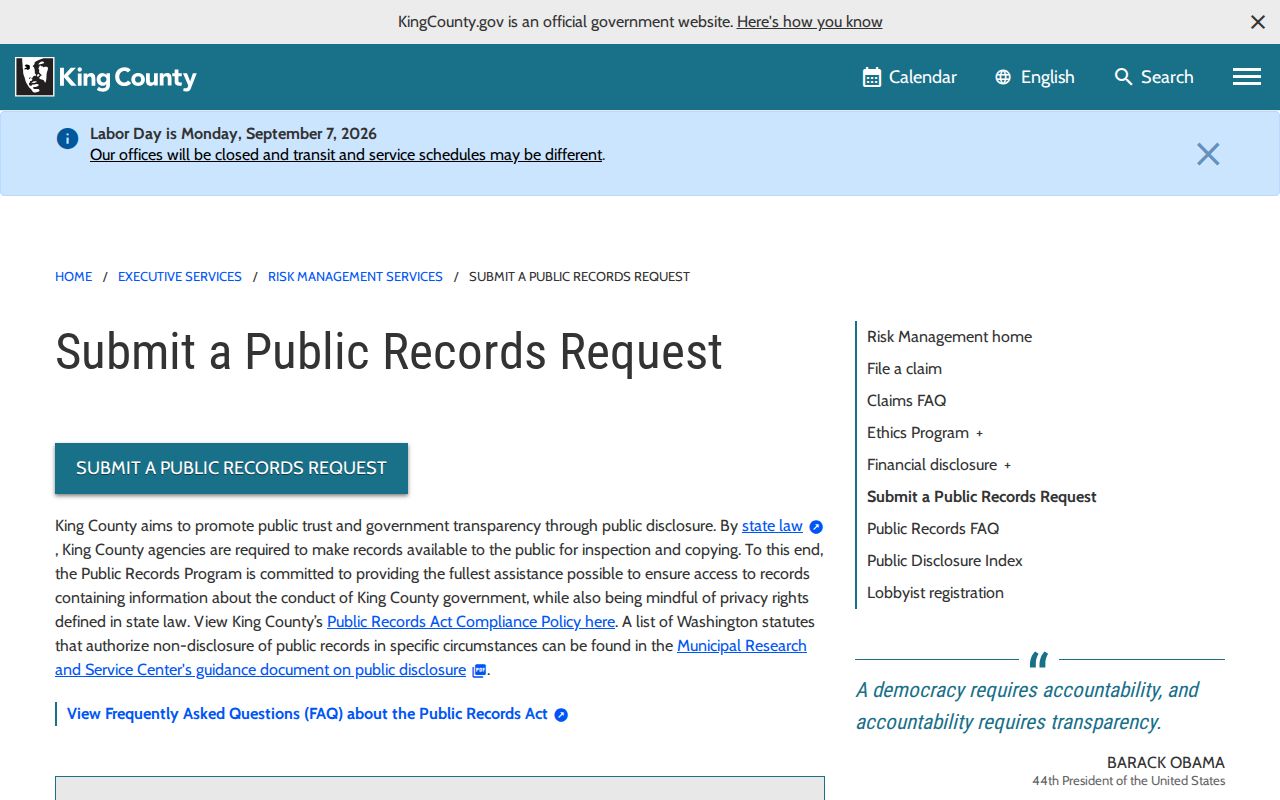
Save the request text, submission date, tracking number, and each agency response as part of the research log.
Historical King County Directories
Seattle Public Library’s Seattle Room holds a selection of directories from 1867 through 1940, and R.L. Polk and other printed volumes are reported from 1876 through 1996, with gaps. The earliest identified Seattle House and Street Directory with reverse address searching is from 1928; full reverse coverage is identified from 1938 onward. The Level 10 collection is non-circulating, so consult the catalog and arrange an appointment where needed.
An old directory may list a name, spouse, street address, occupation or business, and telephone information, depending on the volume. Read the title page, abbreviations, and front matter before interpreting a line. Then compare adjacent years. The full shelf and tracing method belongs to the King County city directory collections.
King County Property Cards Bridge Eras
The 1937–1972 property-card series contains 82,420 records. Cards can include a former building number, former street name, exterior photograph, construction details, and sketch. That makes the series a useful bridge between a modern parcel number and an old directory address. The WPA survey began in 1937 and was completed in 1940, while later cards extend the run.
Do not expect a complete ownership history. The official description warns that cards do not reliably supply every owner, purchase price, tax payment, blueprint, interior view, or exact building location. Puget Sound Regional Archives is the key repository for pre-1990 assessment cards and historical house photographs. Pair a card with the assessor, deeds, and directory years.
Annexation Changes Directory Searches
Seattle annexed several former municipalities between 1905 and 1910. Ballard, Columbia, Georgetown, South Park, Southeast Seattle, South Seattle, West Seattle, and Ravenna can therefore appear under different civic headings across time. The Seattle Municipal Archives annexed-cities reference links ordinances, council minutes, clerk files, warrants, and improvement-district material that can explain the shift.
Ballard rejected annexation in 1905 before approving it in 1907. That two-step story is a reminder to use the record date, not a modern city label. For newer changes, save the date of the KCGIS annexation layer. Five Duvall Big Rock Park parcels have an effective annexation date of January 1, 2026.
Keep a King County Record Log
Record the exact source, search date, spelling, address, parcel number, case number, recording number, volume, and page. Label what each source actually proves: owner of record, recorded party, case party, listed resident, registered voter, or historical household member. A commercial people-finder result may be convenient, but it can merge names, lag behind official changes, and hide its source. Official indexes and custodians provide clearer dates and roles.
- Parcel
- A legally described unit of land identified by a county number.
- Index
- A finding aid that points to a record and may not contain the full document.
- Reverse directory
- A printed directory arranged by street address instead of surname.
- Certified copy
- An official copy authenticated by the record custodian.
Mark uncertain matches as tentative. A second independent identifier can turn a name match into a defensible link, while a conflict should stay visible in the notes.